

Main Application Fields Of Geomembranes
1. Concrete dam project
The geomembrane is used for the repair of the upstream dam surface of the old concrete dam and also for the new dam. The former is when the dam surface of the old dam is used for a long time, the surface corrosion and the water permeability increase, the geomembrane veneer acts as an anti-seepage effect; for the newly built RCC dam, the geomembrane is a good material for the upstream dam surface.

2. Earth and rock dam project
The purpose of geomembrane in earth-rock dam projects is to prevent leakage of dams or dam foundations, both for new dams and for repair and elevation of old dams, including:
(1) used as an upstream inclined wall;
(2) Double-layer lining, which is used as both a sloping wall and an upstream covering;
(3) The dam built on the permeable foundation is double-layered and covered with a single layer membrane as the inclined wall;
(4) single layer covering;
(5) There is a weak layer or an area that is easy to break under the covering part, and a single layer of geomembrane is used for laying, and a geogrid or a high-strength, high-modulus geotextile reinforced soil is used underneath;
(6) using geomembrane as vertical anti-seepage;
(7) The vertical cut-off wall penetrating the dam body can be used for new dams or old dams;
(8) The line-shaped anti-seepage wall is extended upwards in the new dam with the filling construction;
(9) When the old dam is raised, it is used as a seepage prevention wall for heightening part of the dam;
(10) For two dams with different compressibility materials, geomembrane is used on the dam slope at the interface of the two materials to prevent crack leakage;
(11) The old dam leaks water and uses the geomembrane as a diagonal wall;
(12) Repairing ground-based loopholes with geomembrane.

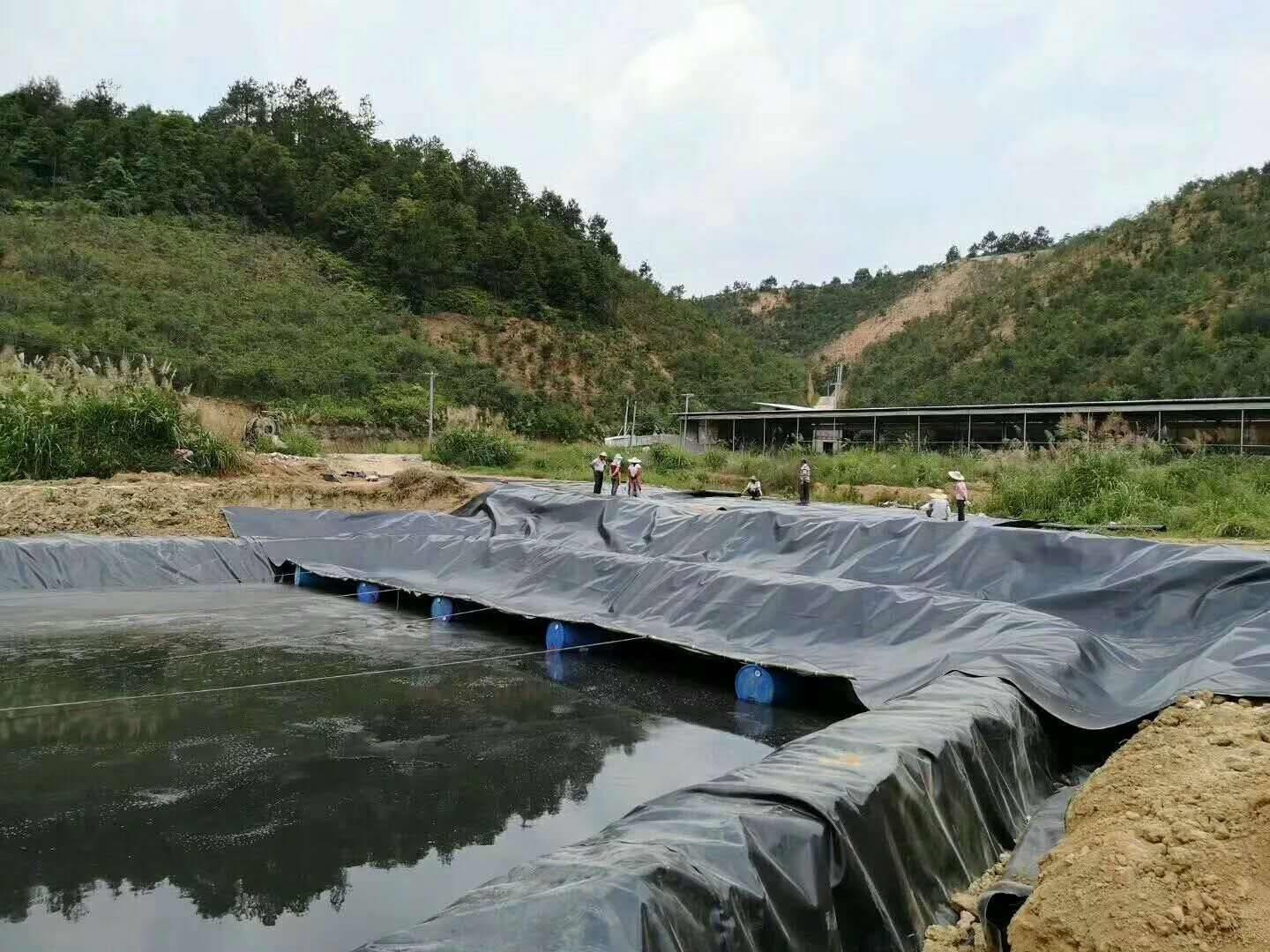
3. Channels and pools
There are many examples of using geomembrane as a channel and pool anti-seepage lining. Significantly, the US Bureau of Reclamation has completed a 300m long geomembrane lining test on the Coachella channel in California. The test PVC geomembrane has a thickness of 0.75 mm, and a 115 g/m2 needle geotextile is adhered thereto, and the concrete sealer is directly placed on it. Each geomembrane has a size of 61 m × 17.9 m and the adhesive agent is tetrahydrofuran. The construction uses a special 160t excavation sloping machine and a 180t underwater paver, all equipped with tracks and mounted on a truss spanning the channel with a span of 31.4m.

4, vertical cut-off wall
The traditional ground vertical anti-seepage measure is to construct a concrete cut-off wall. In recent years, some foreign projects have begun to use a material called a ground lock plate made of a polymer material to insert into the foundation to replace the continuous wall, and the depth can reach 15m or more.
5. Tunnel engineering
Geomembranes are used for both pressureless tunnels and pressurized tunnels. The role of geomembrane in tunnels is mainly for seepage prevention. In order to exclude water seepage from surrounding rock fissures, composite geomembranes with needle-punched geotextiles on the back are often used.


