

What's the difference between Woven geotextile and non-woven geotextile?
Geotextile is a water-permeable geosynthetic material made of synthetic fibers by needle punching or weaving. The finished product is cloth-like, so it is called geotextile, with a width of 4 to 6 meters and a length of 50 to 100 meters.

Geotextiles are divided into: non-woven geotextiles and woven geotextiles
1. Non-woven geotextiles are laid into a network from filament or staple fibers through different equipment and processes, and different fiber bundles (fiber filaments) are intertwined and entangled with each other after needle punching and weaving. Standardize and standardize the woven items, and make the fabric soft, full, thick, and stiff, with the characteristics of cloth, and use this to achieve different thicknesses to meet the requirements of use.
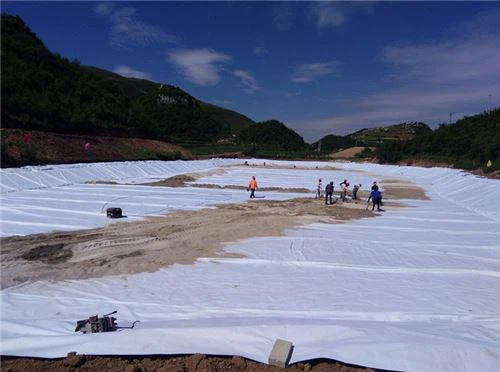
Non-woven geotextiles have good fabric gaps and attachment points, so that the geotextiles have a certain water permeability, adaptability to deformation, and tear resistance; because the surface is soft and there are many gaps, the geotextiles have a good coefficient of friction that can increase Adhesion ability of soil particles.
According to the length of the filament, it is divided into: filament non-woven geotextile, short filament non-woven geotextile; they can all play a good role in filtering, isolation, reinforcement, protection, etc., is a widely used geosynthetic material ; The tensile strength of filament is higher than that of staple, and it can be selected and used according to the specific situation.
Specifically, the non-woven geotextile has: 1. isolation 2. filtration 3. drainage 4. reinforcement 5. protection 6. closure
2. Woven geotextiles are composed of at least two sets of parallel yarns (or flat yarns). One set is along the longitudinal direction of the loom (the direction of the fabric, the long saying goes) is called warp, and the other set The vertical direction of the loom (that is, the horizontal arrangement) is called weft yarn, which weaves the finished product like cloth. Weaving warp and weft yarns into different cloths with different weaving equipment and processes, weaving different thicknesses and densities according to different ranges of use. Generally speaking, there are thin geotextiles, and they have a very strong tensile strength in both the vertical and horizontal directions. Strength (in general, the tensile force in the longitude direction is greater than the latitude direction), and it also has good stability.
Woven geotextiles are divided into: reinforced geotextiles and unreinforced geotextiles according to different weaving techniques and uses.

The tensile strength of the reinforced geotextile is far greater than that of the unreinforced geotextile and ordinary geotextile.
Specifically, the main function of spinning geotextiles is the reinforcement of geotechnical engineering, which has the function of plane isolation and protection, but does not have the function of plane drainage.

According to the above situation, it can be seen that the role of geotextiles is to isolate, strengthen, protect, drain, filter, and close. Due to the different requirements of each project, the geotextiles required are different, and the construction methods are different. If it is, then it must be sewn, and it must be secure; if it is isolation, drainage, filtering, it is OK to use steel wire or blanking 10cm, but it is best to still sew.


